
AT THE HEART OF ISLAND LIFE
Lucio Sanz — “An Angel”
An interview with the visionary artist
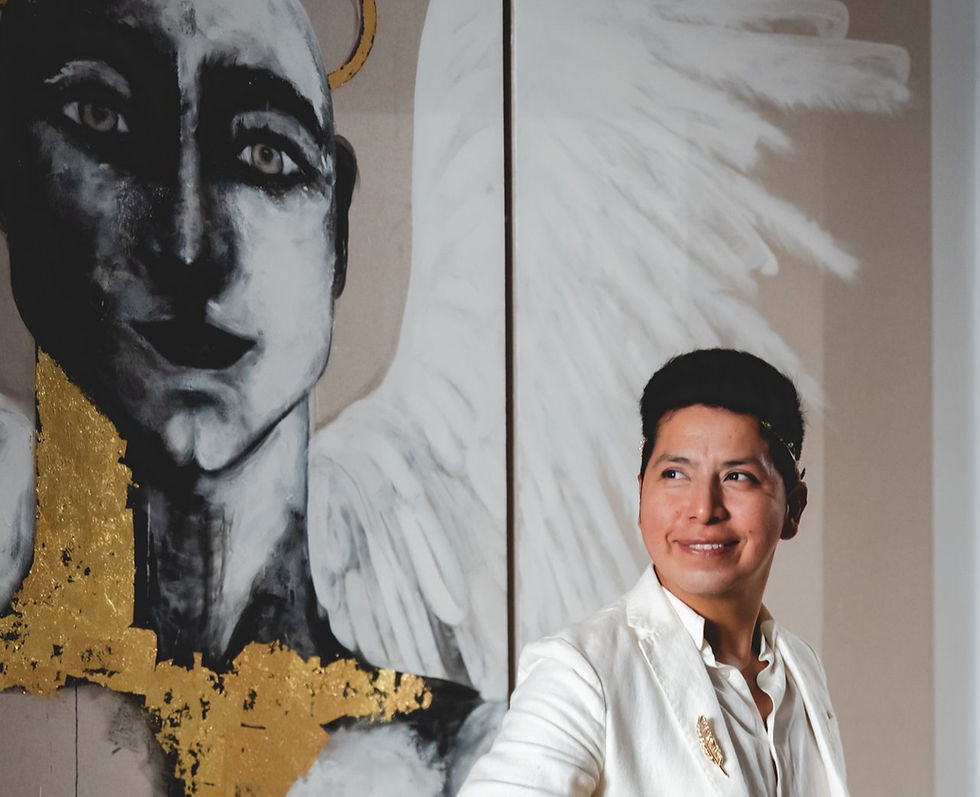
Writer Mar Piris meets Lucio Sanz—now known artistically as Ángel Lucio Sanz—at his stunning home in Muro, a centuries-old house he has transformed into a living gallery. Walls, patios, and hidden corners hold pieces from across his creative journey, including his newest exhibition, Universo. In this intimate setting, surrounded by monumental wings, ancestral echoes, and the quiet magic of Mallorca, Lucio opened his doors and his story.
By Mar Piris
21/11/25
Lucio Sanz, that golden dream. How did Mallorca choose you?
First, thank you for being here, Mar. Your energy is beautiful, like this island. And thank God, because I feel that little by little I am fulfilling the path He has laid out for me.
My relationship with Mallorca began long before I ever arrived. I was nine when I dreamed of a luminous island, covered in golden wheat, surrounded by gentle mountains and children who radiated peace. In that dream I was taken to a woman who spoke to me about the future. Years later, my mother explained that wheat symbolises abundance. The dream never left me.
Time passed. I trained, worked, and at 25—thanks to a unique opportunity from the Panamanian Embassy in Lima—I was sent to Spain as a promising young designer. I arrived in Madrid, and there, for the first time, I heard someone speak of Mallorca. Something stirred in me. I decided to go.
The plane made a strange manoeuvre, as if fate wanted to underline the moment. When I looked out the window and saw the turquoise waters and lush green of the island, I felt Mallorca embracing me. It mesmerised me. I knew instantly that I had to stay here, create here… even die here.
I walked through the old town, the cathedral, the landscapes, and it was as if the island revealed its soul to me—and awakened mine. I left the hospitality industry, studied interior design, found work quickly… but something inside whispered that this wasn’t yet my path. While working as a designer, I began creating pieces without knowing they were art: sculptures, paintings, objects that emerged intuitively, almost mysteriously.
It was as if God and the universe already knew what I had not yet understood: that art was my destiny.
And today, seeing what I’ve created, and seeing you here interviewing me for a cultural magazine from the very island I dreamed of as a child… I can only say: this is how God works. This is how Mallorca speaks. This is how the universe manifests.
What are your roots? And how do they live in your work?
I’m from Lima, Peru. I was born into a beautiful and deeply religious family. But it was actually here, in Mallorca, that I learned to value and love my culture. Spanish friends would tell me about Peru—its wonders, its history—and I realised how much I didn’t know. That sparked a search that changed me. I began studying our textiles, our architecture, our ancestral symbols. Curiously, I learned to love Peru from a distance.
In 2024 I created Viru, an exhibition I initially intended only for my garage and patio. But it overflowed—literally. People filled my entire house, from the living room to the kitchen. The response was overwhelming.
Viru is the ancient Quechua name of Peru, meaning “big river.” It was Pizarro who later renamed it: the P for Pizarro, the E for España. And so “Peru” was born.
After Viru, I created Sipan, a natural continuation inspired by the Lord of Sipán—the Latin American Tutankhamun. His tomb held thousands of pieces of gold, ceramics, textiles… a discovery that transformed the continent’s archaeological history. My own sculptures incorporate huacos, Inca ceremonial vessels with personalised faces. They once held chicha, a fermented drink of corn and chancaca. I imagine the Incas celebrating life in their mountains with these sacred objects.
I work from an ancestral perspective, but I think big. My sculptures are colossal. I need large spaces—my patio, perhaps eventually the house next door. When I create, I set no limits. People see my pieces and say: “That’s a Lucio.”
And that, to me, is everything.


Meeting at House Todo y Nada
We sit today in my gallery, House Todo y Nada, in Muro. It’s a space where my art merges with the original architecture of the house. Here I present Viru, a tribute to my homeland, its history, and above all to love—which, for me, was the true conquest.
One of my favourite pieces is The Conquest, where an Inca princess falls in love with Pizarro. I covered her in gold to symbolise that union and the cultural richness that survives beyond the official narratives. I’m a romantic; I believe that love must be present in everything—especially art.
During the pandemic, I began tearing and reusing materials—old clothes, cardboard, anything that had lived. That process took my work to another level: creative, sustainable, authentic. People feel that truth.
Why the alias “Ángel”? And why are there angels in your work?
When I bought this house, I renovated it with the help of a young man. He looked at me with a tenderness I couldn’t explain. He barely knew my story, yet he seemed to see something beyond it.
One day, a woman knocked, looking for the previous owner. He told her, “She doesn’t live here anymore. An angel lives here now.” I heard him from the patio. She insisted: “But didn’t María live here?”
And he said again, with complete certainty: “No, ma’am. An angel lives here.” Then he pointed at me: “Here is the angel.”
I laughed and said, “Rafa, the exhibition is called Angel, but that's not my name.”
Yet the same thing kept happening. At the town hall, the secretary called me Angel. People I barely knew called me Angel. A name that wasn’t mine… or perhaps it was.
I believe in angels. I adore them. I even held an exhibition dedicated to them. And now life keeps placing that name before me. Mar, you confirmed it without knowing: “You’re baptised,” you told me.
So I’ve decided to adopt it as my artistic name: Ángel Lucio Sanz.
Ángel, because that is how they see me.
Lucio, because that is my essence.
Sanz, for my family—and because it reminds me of Alejandro Sanz, whom I admire.


An interview with the visionary artist
Writer Mar Piris meets Lucio Sanz—now known artistically as Ángel Lucio Sanz—at his stunning home in Muro, a centuries-old house he has transformed into a living gallery. Walls, patios, and hidden corners hold pieces from across his creative journey, including his newest exhibition, Universo. In this intimate setting, surrounded by monumental wings, ancestral echoes, and the quiet magic of Mallorca, Lucio opened his doors and his story.


Meeting at House Todo y Nada
We sit today in my gallery, House Todo y Nada, in Muro. It’s a space where my art merges with the original architecture of the house. Here I present Viru, a tribute to my homeland, its history, and above all to love—which, for me, was the true conquest.
One of my favourite pieces is The Conquest, where an Inca princess falls in love with Pizarro. I covered her in gold to symbolise that union and the cultural richness that survives beyond the official narratives. I’m a romantic; I believe that love must be present in everything—especially art.
During the pandemic, I began tearing and reusing materials—old clothes, cardboard, anything that had lived. That process took my work to another level: creative, sustainable, authentic. People feel that truth.
Why the alias “Ángel”? And why are there angels in your work?
When I bought this house, I renovated it with the help of a young man. He looked at me with a tenderness I couldn’t explain. He barely knew my story, yet he seemed to see something beyond it.
One day, a woman knocked, looking for the previous owner. He told her, “She doesn’t live here anymore. An angel lives here now.” I heard him from the patio. She insisted: “But didn’t María live here?”
And he said again, with complete certainty: “No, ma’am. An angel lives here.” Then he pointed at me: “Here is the angel.”
I laughed and said, “Rafa, the exhibition is called Angel, but that's not my name.”
Yet the same thing kept happening. At the town hall, the secretary called me Angel. People I barely knew called me Angel. A name that wasn’t mine… or perhaps it was.
I believe in angels. I adore them. I even held an exhibition dedicated to them. And now life keeps placing that name before me. Mar, you confirmed it without knowing: “You’re baptised,” you told me.
So I’ve decided to adopt it as my artistic name: Ángel Lucio Sanz.
Ángel, because that is how they see me.
Lucio, because that is my essence.
Sanz, for my family—and because it reminds me of Alejandro Sanz, whom I admire.


“Universo”, your new exhibition for 2025
Universo is a thank you.
To God. To life. To my parents. To this magical island that has given me so much. It is my offering to the Creator for His colossal work: the beaches, the forests, true friendships, the smiles that heal.
This exhibition hasn’t been easy. I’ve always worked intensely, but Universo demanded more. The trials were difficult, sometimes painful. Yet everything aligned. Today, walking through this house—which is also part of the artwork—I feel only respect and gratitude. I am merely its guardian. The house speaks. It invites.
One of the surprises is the work “María.” It was inspired by emotional moments in the life of Jesus, by the Bible, and by my everyday life. When I began creating it, the piece began to crumble due to a reaction with the sandstone wall. It transformed. My sister said, “Call her María.”
And so I did. Because beauty lives in imperfection—and this piece radiates peace.
In Universo, I also invite people to vibrate higher, to call on the light, to connect with the angels—visible and invisible—who surround us. I don’t believe this is the end of the world. On the contrary: it is the beginning of something more conscious, more loving. If you treat others with tenderness—a smile, a hug—everything changes.
The centrepiece is a pair of colossal wings, handmade feather by feather. Each feather cut from recycled fabrics: worn clothes, curtains, scraps donated by friends. They took me a year. They’re not parade wings—they are wings for flight. Wings to cross oceans.
A psalm guided me through this work:
“He will cover you with His feathers, and under His wings you will find refuge.”
That promise—refuge, strength—is the heart of Universo. Because art, like faith, is an act of hope.
What memories do you keep from your childhood?
“The Hand That Saved Me”
There is a memory that has never left me. I was a mischievous child, extremely curious. One day, following someone else’s prank, I ran faster than ever, almost flying from fear. Without realizing it, I entered a forbidden area. Suddenly I opened my eyes and saw enormous metal bars inches from my face. I was about to fall. About to die.
And then a hand caught me.
A strong, firm hand.
I don’t know whose hand it was or how it appeared. I only know that it saved my life.
I remember the sky at sunset, the moon starting to rise. I walked home pale—though dark-skinned, that day I returned white. I said nothing; I feared being scolded for my mischief. But I never forgot that hand. I still wonder where it came from. Yet I’ve always felt it was real, as if destiny—or something greater—intervened.
To meet Ángel Lucio Sanz is to understand that art is not something he creates—it is something that moves through him. His journey from a childhood vision of an island of light to the patios and stone walls of Muro feels less like chance and more like destiny unfolding. His work bridges continents, cultures, and worlds—earthly and divine—reminding us that beauty is born from memory, that identity is a form of love, and that emotion is the most sacred language we possess. In his hands, Mallorca becomes both sanctuary and canvas; Peru becomes heartbeat and heritage; and art becomes prayer. Ángel Lucio Sanz does not simply sculpt wings—he invites us to find our own.
“Universo”, your new exhibition for 2025
Universo is a thank you.
To God. To life. To my parents. To this magical island that has given me so much. It is my offering to the Creator for His colossal work: the beaches, the forests, true friendships, the smiles that heal.
This exhibition hasn’t been easy. I’ve always worked intensely, but Universo demanded more. The trials were difficult, sometimes painful. Yet everything aligned. Today, walking through this house—which is also part of the artwork—I feel only respect and gratitude. I am merely its guardian. The house speaks. It invites.
One of the surprises is the work “María.” It was inspired by emotional moments in the life of Jesus, by the Bible, and by my everyday life. When I began creating it, the piece began to crumble due to a reaction with the sandstone wall. It transformed. My sister said, “Call her María.”
And so I did. Because beauty lives in imperfection—and this piece radiates peace.
In Universo, I also invite people to vibrate higher, to call on the light, to connect with the angels—visible and invisible—who surround us. I don’t believe this is the end of the world. On the contrary: it is the beginning of something more conscious, more loving. If you treat others with tenderness—a smile, a hug—everything changes.
The centrepiece is a pair of colossal wings, handmade feather by feather. Each feather cut from recycled fabrics: worn clothes, curtains, scraps donated by friends. They took me a year. They’re not parade wings—they are wings for flight. Wings to cross oceans.
A psalm guided me through this work:
“He will cover you with His feathers, and under His wings you will find refuge.”
That promise—refuge, strength—is the heart of Universo. Because art, like faith, is an act of hope.
What memories do you keep from your childhood?
“The Hand That Saved Me”
There is a memory that has never left me. I was a mischievous child, extremely curious. One day, following someone else’s prank, I ran faster than ever, almost flying from fear. Without realizing it, I entered a forbidden area. Suddenly I opened my eyes and saw enormous metal bars inches from my face. I was about to fall. About to die.
And then a hand caught me.
A strong, firm hand.
I don’t know whose hand it was or how it appeared. I only know that it saved my life.
I remember the sky at sunset, the moon starting to rise. I walked home pale—though dark-skinned, that day I returned white. I said nothing; I feared being scolded for my mischief. But I never forgot that hand. I still wonder where it came from. Yet I’ve always felt it was real, as if destiny—or something greater—intervened.
To meet Ángel Lucio Sanz is to understand that art is not something he creates—it is something that moves through him. His journey from a childhood vision of an island of light to the patios and stone walls of Muro feels less like chance and more like destiny unfolding. His work bridges continents, cultures, and worlds—earthly and divine—reminding us that beauty is born from memory, that identity is a form of love, and that emotion is the most sacred language we possess. In his hands, Mallorca becomes both sanctuary and canvas; Peru becomes heartbeat and heritage; and art becomes prayer. Ángel Lucio Sanz does not simply sculpt wings—he invites us to find our own.